Core Web Vitals in 2026: What Actually Moves Rankings
LCP, INP and CLS explained without the fluff, and where they really sit in Google's ranking stack.
Core Web Vitals get treated like a magic ranking lever every time Google mentions them, and then treated like a myth the moment someone points out a slow page that still ranks first. Both reactions are wrong. Here is what the three metrics actually measure, how Google scores them, and where they really sit in the ranking stack in 2026.
The three metrics, plainly
Three numbers, each measuring a different way a page can frustrate someone.
| Metric | What it measures | Good threshold |
|---|---|---|
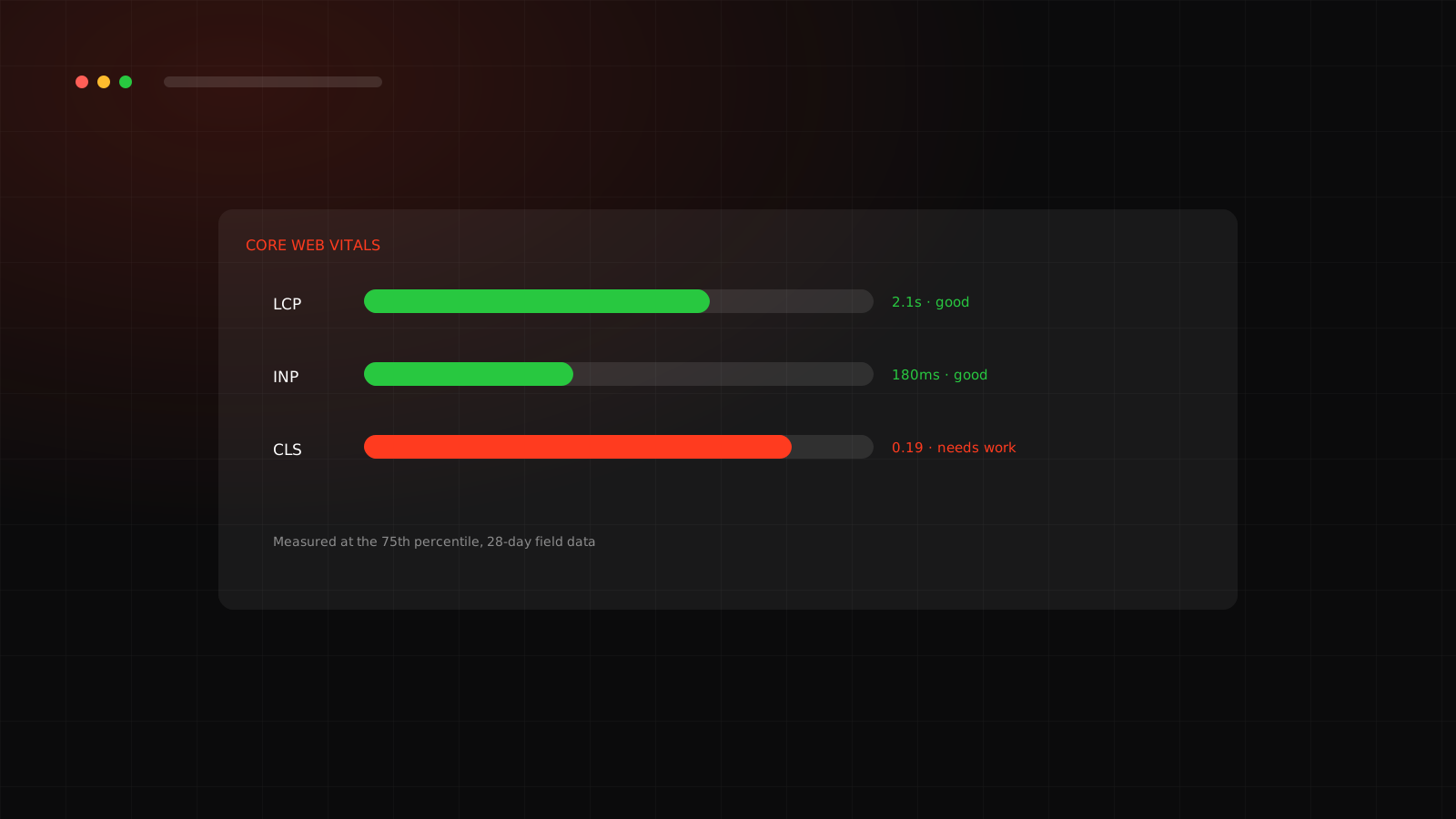
| LCP (Largest Contentful Paint) | How long until the biggest visible element loads | Under 2.5 seconds |
| INP (Interaction to Next Paint) | How long the page takes to visibly respond to a click, tap or keypress | Under 200 milliseconds |
| CLS (Cumulative Layout Shift) | How much visible content jumps around while loading | Under 0.1 |
INP is the newest of the three in spirit: it replaced First Input Delay in March 2024 because FID only measured the delay before the browser started processing an interaction, not how long the actual response took. INP measures the whole thing, which is why a page can pass FID-style checks and still feel sluggish to tap through.
How Google actually measures them
None of these three numbers come from a lab test running once on Google's servers. They come from the Chrome User Experience Report (CrUX): real visits, from real people, on real devices and real connections, aggregated over a rolling 28-day window. A page needs the 75th percentile of those real visits to clear each threshold, meaning three out of every four real visits need to have a good experience, not just the fast ones on a fibre connection in a lab.
Where they sit in the ranking stack
Google has been fairly consistent on this since folding Core Web Vitals into page experience signals in June 2021: content relevance is still the dominant factor. Core Web Vitals function closer to a tiebreaker. Between two pages Google considers similarly relevant to a query, the one with the better, more stable experience tends to get the nod. A page that badly fails all three metrics can still get held back even with strong content, but no amount of speed rescues a page that simply is not the best answer to the query.
What usually needs fixing
Across the D2C sites we audit, the same handful of causes account for most Core Web Vitals failures:
Want your real Core Web Vitals numbers, not a guess?
We run field-data audits before touching a line of code.
If your product pages are also missing schema markup, that is a separate and equally fixable gap, covered in what still earns rich results in 2026. And if Google is not even reliably indexing your newer pages, the underlying cause is often a crawl budget problem, not a Core Web Vitals one.
Frequently asked questions
Not the biggest one. Content relevance still decides who ranks. Core Web Vitals act more like a tiebreaker: when two pages are similarly relevant, the faster, more stable one tends to edge ahead, and a page failing badly enough can get held back regardless of content quality.
Interaction to Next Paint (INP) replaced First Input Delay in March 2024. INP measures the full delay from any interaction to the next visual update, not just the first one, which makes it a stricter and more representative metric.
To get an overall 'good' assessment for a page, yes, all three (LCP, INP, CLS) need to pass at the 75th percentile of real user visits over a rolling 28-day window. Passing two out of three still leaves the page rated 'needs improvement.'