Signs Your Meta Ads Agency Isn't Working
Not every underperforming account is a bad-agency problem. Here's how to tell the difference between a hard market and a hands-off one.
Every Meta Ads account underperforms sometimes. iOS changes, seasonality, a category getting more competitive, a genuinely tough quarter, none of that is automatically a sign your agency has stopped working. This isn't a piece about firing anyone. It's a way to tell the difference between an account fighting a hard market and an account nobody is really working on.
It's rarely just a CAC problem
Rising CAC on its own tells you almost nothing. CAC moves with the auction, the season, the category, and the offer, not just with agency effort. The useful question isn't "did CAC go up," it's "can anyone explain why, in a way that matches what actually happened in the account." A good agency, even in a bad month, can walk you through the specific campaigns, audiences, or creatives behind the number. If the answer is a shrug or a vague reference to "the algorithm," that's the actual signal, not the CAC number itself.
Reporting you can't act on
There's a difference between a report and a screenshot of Ads Manager with a paragraph pasted underneath it. Useful reporting tells you what changed, why, and what happens next. If every monthly update reads the same regardless of what the account actually did that month, the reporting has become a formality, not a decision-making tool.
No real testing pipeline, just the same three ads
Meta Ads accounts need a steady supply of new creative to test, not because testing is fashionable, but because creative fatigue is a real and measurable phenomenon: frequency climbs, CTR slides, and the same three ads that worked in month one quietly stop working by month three. If your account has been running the same handful of creatives for months with no new variants queued, there's no testing pipeline, whatever the monthly deck calls it.
Budget moves without a reason you understand
Scaling decisions should follow a logic you can restate in one sentence: we're increasing budget on X because Y is happening, or we're pulling back on Z because it stopped being efficient at this spend level. If budget moves up or down and the explanation is "let's see what happens," that's not a strategy, it's a guess with your money.
The whole account rides on one campaign
A single dominant campaign carrying most of an account's spend and results isn't automatically wrong, sometimes that's just what's working. But it becomes a real risk when there's no visible plan for what happens if that one campaign fatigues, gets restricted, or simply stops scaling. Ask what the backup plan is. If there isn't one, the account has a single point of failure nobody has acknowledged.
A ten-minute audit you can run yourself
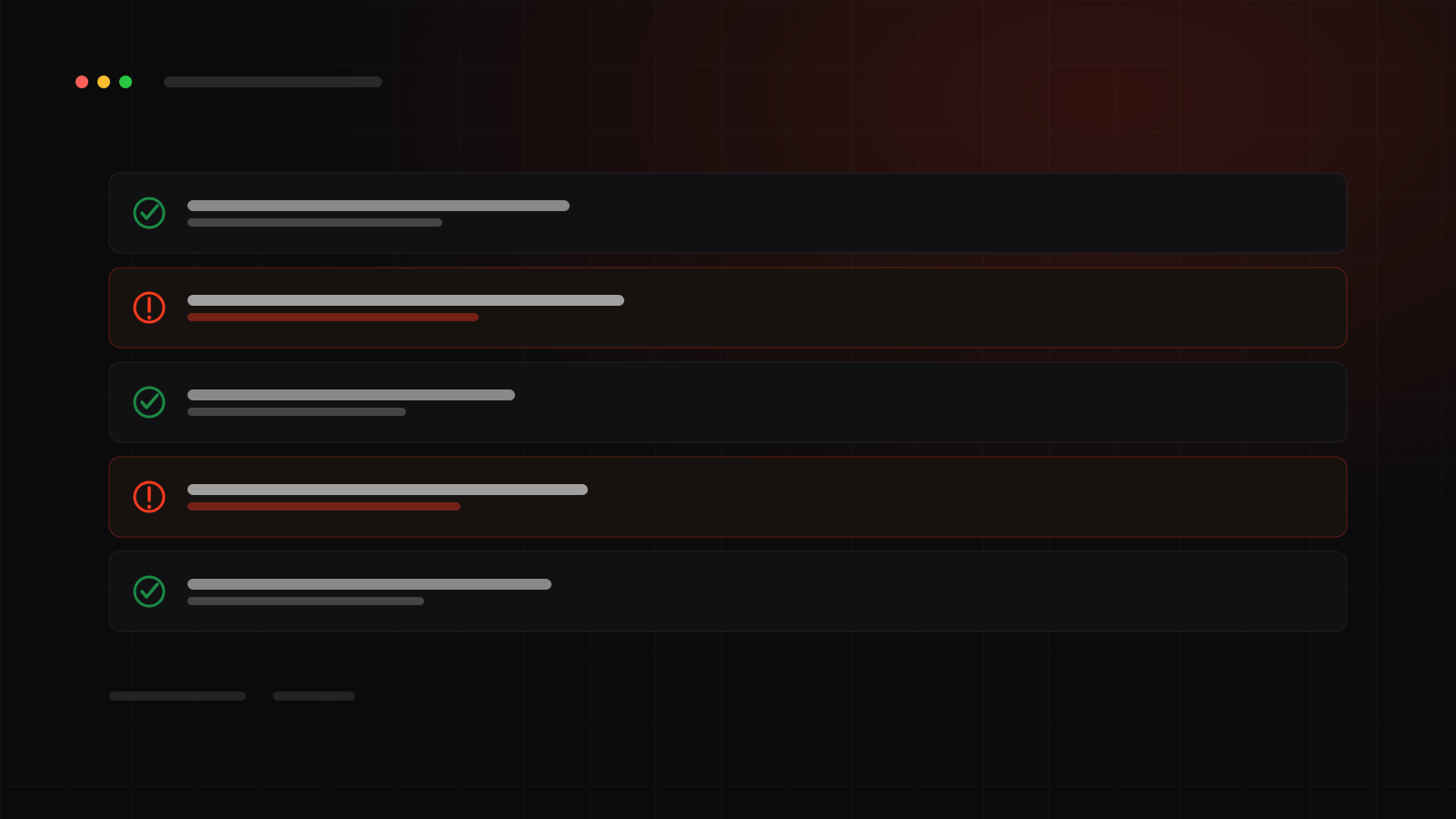
You don't need to be a media buyer to check most of this. Pull up the account, or your last three monthly reports, and go through these:
Three or more "no" answers is a real pattern, not noise. One or two is worth a conversation, not a panic.
What a working relationship actually looks like
None of this is about finding a perfect account. Good months and bad months both happen inside a healthy engagement. The difference is whether someone can tell you why, with specifics, and whether the next move has a stated reason behind it. That's a lower bar than "always winning," and it's the one that actually separates a genuine effort from an account on autopilot.
Want a second opinion on your account?
We'll run this same audit on your actual account and tell you plainly what we find, whether or not you switch.
If your audit turned up more "no" answers than you'd like, the next step usually isn't finding a new agency, it's finding the actual root cause. Start with how Meta Ads should be structured and run to know what you're comparing against. And if the honest conclusion is that no agency has managed this well, it's worth asking whether an agency is even the right model before hiring another one.