Supplement Brand CAC and ROAS Benchmarks in India: What's Actually Realistic
Meta-led CAC jumped 32% in a single year. Here's what a healthy supplement brand's numbers actually look like in 2026.
Every founder asks the same question in the first five minutes of a call: is my CAC too high? For supplement brands specifically, the honest answer in 2026 depends less on a single number and more on whether that number sits inside a ratio that actually holds up.
The headline numbers for 2026
Meta ad CAC for Indian D2C brands broadly climbed from roughly ₹381 in 2025 to about ₹502 in 2026, a 32% jump in a single year, with blended CAC across categories up around 35% year over year. Categories with heavier creative and compliance demands, which increasingly includes supplements given the policy changes covered in Meta's 2026 rewrite, tend to sit toward the higher end of that range rather than the lower end.
Why CAC is rising specifically in this category
Two forces compound in supplements specifically. First, general auction pressure: more brands competing for the same high-intent audience naturally pushes cost per acquisition up across the board. Second, the compliance overhead covered in the policy piece above means weaker, vaguer creative gets rejected or under-delivered more often, which concentrates spend onto fewer approved ad variants and reduces the natural cost-efficiency that comes from creative diversity.
The ratio that matters more than either number alone
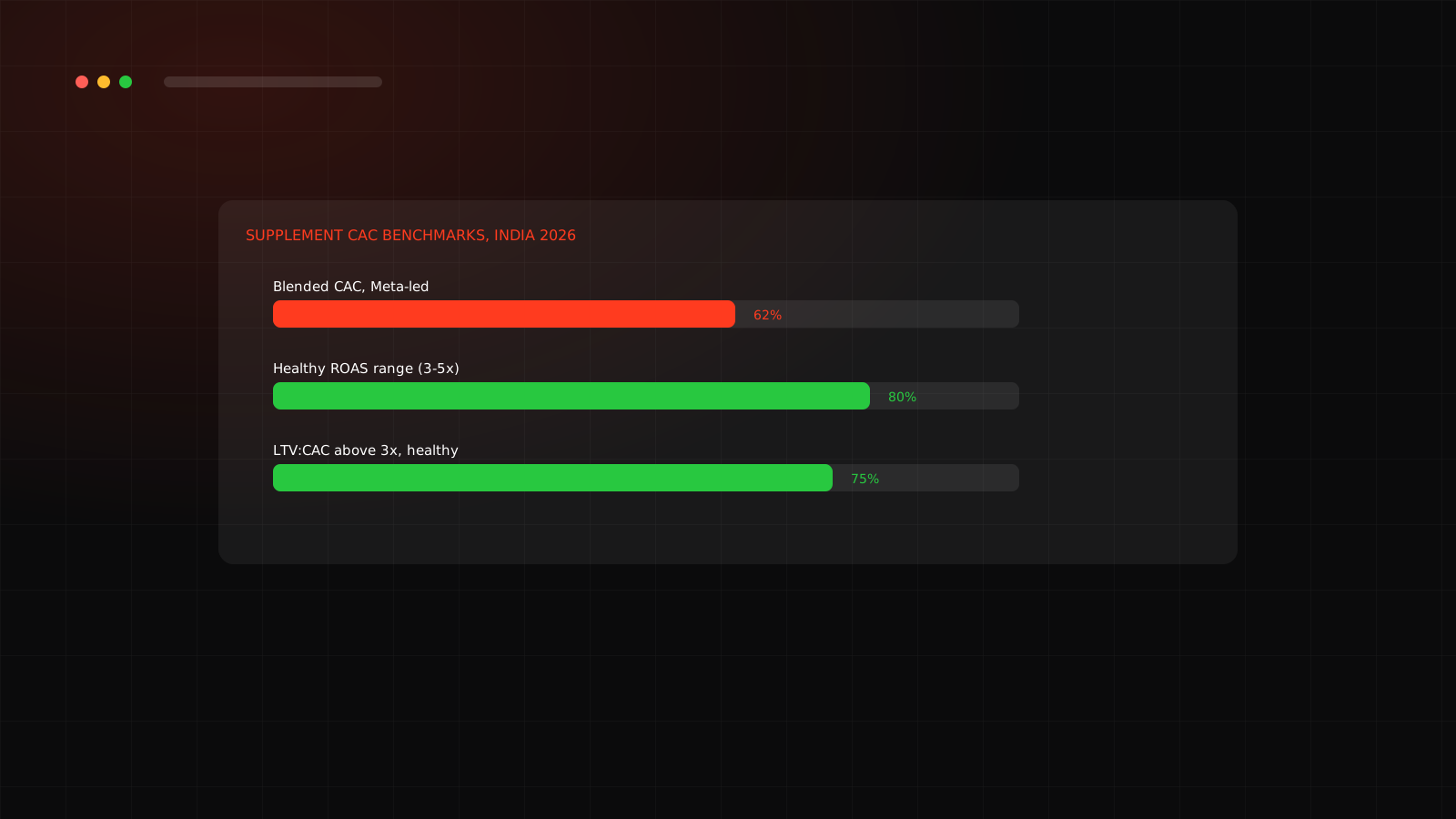
LTV to CAC is the number that actually determines whether a rising CAC is a crisis or just a cost of doing business. The healthy band for most D2C categories is 3:1 to 5:1. Below 2:1, acquisition costs more than the customer is worth and the underlying model is broken regardless of how good the ads look. Above 5:1 often signals the opposite problem: under-investment in growth, leaving cheap acquisition opportunity on the table. Many Indian D2C brands currently operate in the 1.5x to 2.5x range, which is workable only if retention is actively being built, not assumed.
| LTV:CAC ratio | What it means |
|---|---|
| Below 2:1 | Acquisition is unprofitable; fix retention or targeting before scaling spend |
| 2:1 to 3:1 | Workable but fragile; retention needs active investment |
| 3:1 to 5:1 | The healthy band for most D2C categories, supplements included |
| Above 5:1 | Likely under-investing in growth; room to spend more |
What to actually do about it
Not sure if your numbers are actually healthy or just familiar?
We benchmark against real category data, not a generic industry average.
If CAC is climbing because creative keeps getting rejected, the fix is upstream: see UGC scripts that sell supplements without getting flagged.
Frequently asked questions
Meta-led CAC for Indian D2C brands generally sits in a wide band depending on category maturity, but blended CAC across categories rose roughly 35% year over year into 2026, with Meta ad CAC specifically climbing from about ₹381 in 2025 to around ₹502 in 2026.
A healthy ROAS for Indian D2C brands on Meta and Google is typically in the 3x to 5x range. Below that consistently signals a targeting, creative or landing page problem worth diagnosing rather than just increasing budget.
Not alone. Supplements are a repeat-purchase category, so LTV:CAC and subscription retention matter more over time than first-order ROAS. A brand can have a mediocre first-order ROAS and still be healthy if retention is strong.